On August 19, 2026, the U.S. Treasury announced that it would at least double the size of its liquidity-support buyback operations in the 10-to-20-year and 20-to-30-year maturity sectors.
The current maximum of $2 billion per operation will rise to at least $4 billion, effective September 9 through November 4, 2026, the end of the quarterly refunding period. The following day, Scott Bessent added that the figure could exceed $4 billion per issue and that the Treasury would “make a market” in those maturities, according to the Treasury.
It is worth putting the scale in context before talking about monetization. In its August 5 quarterly refunding announcement, the Treasury had already planned to buy back up to $38 billion in off-the-run securities for liquidity support and up to $25 billion in the one-month-to-two-year sector for cash-management purposes during the quarter, according to Treasury Department data. The August expansion adds at least another $14 billion, raising the maximum buybacks for the August 6–November 5 period from $69 billion to $83 billion, according to Reuters.
We are talking about an additional $14 billion in a market with nearly $30 trillion in marketable debt outstanding. The amounts are small, the operation is temporary, it does not alter the average maturity of outstanding debt, and it is not quantitative easing.
Why it is not quantitative easing.
When the Federal Reserve conducts QE, it buys a bond from the private sector and creates bank reserves on the liability side of its balance sheet. The consolidated public sector removes duration from private portfolios while simultaneously expanding the monetary base. That is new money.
When the Treasury repurchases a bond, it pays with money that already exists: cash from the Treasury General Account, obtained through new debt issuance or tax revenues. Not a single reserve is created. It is an exchange of instruments within the private sector’s portfolio. The investor hands over an illiquid long-term bond and receives cash, which, in aggregate, returns to the Treasury through Treasury bill auctions. As I explained in the past, the Fed can print money and buy whatever it can; the Treasury cannot. It must finance buybacks by issuing more bills—in this case, issuing the same amount it had already planned. It does not even increase the debt.
What the operation does alter is the maturity composition of the debt supplied to the market: less long-duration debt and more short-term paper. That is debt management with a curve bias, not monetary policy. It is a decision intended to mitigate the negative effect of Janet Yellen’s previous Treasury strategy of concentrating debt maturities at the very short end, in an environment in which the Biden administration was pushing public spending more than $2 trillion above the extraordinary Covid-era peak.
It is a debatable decision, but it is not money creation.
How Yellen did it.
The modern buyback program was announced in May 2023 and began operating in May 2024 under Janet Yellen. Between May and July 2024, the Treasury purchased $11.23 billion in par value across nine operations. Between May 29 and October 23, 2024, it conducted 21 liquidity-support operations and four cash-management operations. It offered to repurchase up to $43 billion and received roughly $148 billion in offers. The communicated ceiling was $30 billion per quarter for liquidity-support operations and a maximum of $120 billion annually for cash-management buybacks, later raised to $150 billion, according to the Office of Debt Management. Since the program began in May 2024, the Treasury has repurchased $239 billion in 91 operations against $1.13 trillion offered.
In other words, over more than two years, the entire program under Yellen and now Bessent has accumulated $239 billion, and most of it has been concentrated in the one-month-to-two-year segment for cash-management reasons, not at the long end.
One month of QE3 was equivalent to nearly the entire buyback program during its first half-year of operations. Bessent’s expansion—an additional $14 billion in one quarter—represents less than 2% of the size of Operation Twist.
The three channels through which a Treasury buyback could be inflationary are closed.
Reserves. None are created. The data confirm that the system is contracting, not expanding. Bank reserves at the Fed stood at $2.935 trillion on August 19, 2026, while total reserves fell from $3.356 trillion in June 2025 to $3.019 trillion in June 2026—roughly $337 billion less over one year. The Fed’s balance sheet stood at $6.746 trillion on August 19, below the $6.760 trillion of the preceding week.
Money supply. M2 reached $23.155 trillion in June 2026, compared with $21.943 trillion a year earlier, an annual growth rate of 5.5%. That is a low nominal pace, below the historical median since 1960. More importantly, it has nothing to do with buybacks: it reflects bank credit, not an exchange of bonds for bills.
Velocity. M2 velocity was 1.412 in the second quarter of 2026, virtually unchanged from 1.412 in the first quarter and 1.395 one year earlier. There is no acceleration. A buyback financed with bills does not alter anyone’s demand for money. The bondholder shifts from a long-term asset to a short-term asset, both close substitutes for cash in an institutional portfolio.
If someone wants to look for reserve creation, the right place is not the Treasury today but the Fed.
What does deserve criticism is something else: the growing dependence on short-term paper. Treasury bills already account for around 22% of marketable debt outstanding, above the 15%–20% range recommended by the Treasury Borrowing Advisory Committee itself. That is not monetary inflation; it is refinancing risk. Funding a structural deficit with four-week maturities leaves the Treasury exposed to every movement in short-term interest rates. That is the problem—not some supposedly activated printing press.
The scare is misdirected.
This is the analytical error in the consensus of the past two weeks. The market has decided that this is a U.S. story. Yet the evidence suggests the opposite.
If the problem were exclusively American, investors would be buying German bonds. The Bund is, by construction, the eurozone’s safe-haven asset. In 2011, 2016, and 2020, every episode of risk aversion centered on another jurisdiction translated into falling German yields. That is not happening now.
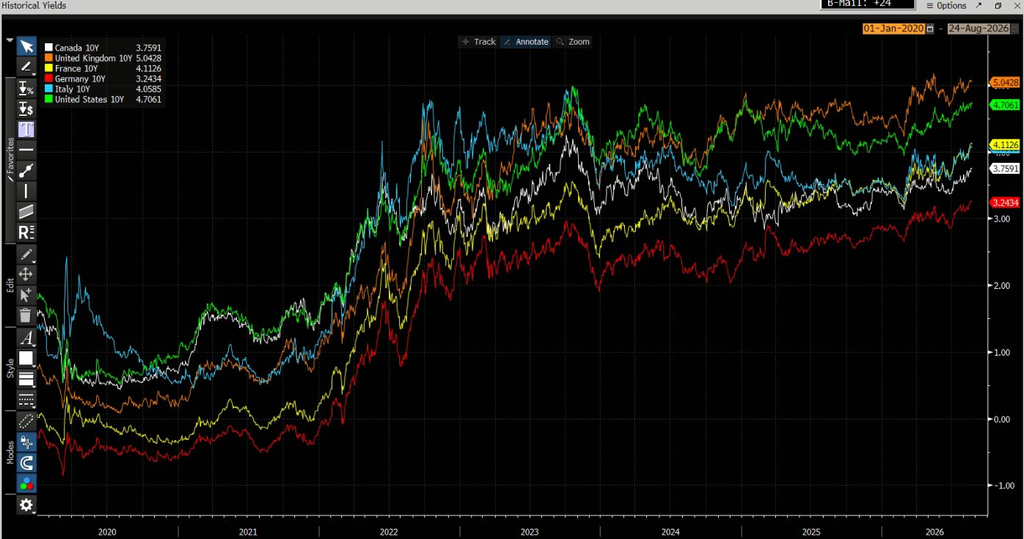
On August 18, the 10-year Bund reached 3.275%, its highest level since 2011. The 10-year French bond hit highs not seen since 2008, 30-year UK gilts approached 6%, and the 10-year Japanese government bond reached 2.945%, a level not seen since September 1996. The 30-year U.S. Treasury yield jumped above 5%, its highest since 2007.
A comparative analysis of 10-year yields since 2020—Canada at 3.76%, the United Kingdom at 5.04%, France at 4.11%, Germany at 3.24%, Italy at 4.06%, and the United States at 4.71% as of August 24, 2026—shows six curves moving in parallel, with the same upward turn and the same slope. There is no divergence. There is no flight to safety. There is a synchronized repricing of sovereign risk throughout the developed world.
The German 10-year bond yield is at its highest level in 15 years. If global investors were only concerned about U.S. debt, German bonds would be strengthening. It is not the case. The market is repricing G8 sovereign debt, discounting widespread higher borrowing and fiscal unsustainability.
Long-term sovereign bonds have ceased to be the unquestioned safe asset. Investors are pricing in inflation risk, fiscal deterioration, excess debt supply, and central banks’ inability to keep masking budgetary irresponsibility. That is also why gold is rising. The market is not rotating from the United States into Europe; it is moving out of sovereign duration generally.
Fiscal policy does not reward the winner; it punishes the one that fails first. And the leading candidate to fail first is not the United States.
The United States retains the world’s reserve currency and the deepest, most liquid sovereign-bond market on the planet. That does not eliminate its debt problem, but it changes how the problem is transmitted. The eurozone has neither of those two advantages and has three disadvantages of its own.
First, hidden liabilities. Maastricht debt includes only currency and deposits, loans, and debt securities, consolidated and measured at face value. It excludes the rest of public-sector balance sheets and, above all, implicit commitments. Official European Commission estimates place accrued net liabilities from public pensions at around 150% of GDP after deducting future contributions, with gross pension promises close to 371% of GDP. This excludes much of the future pressure from healthcare and long-term care. Commitments assumed but not issued exceed 300% of GDP in key euro-area countries.
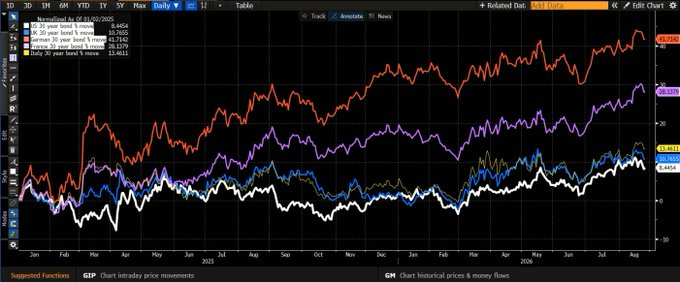
Second, fiscal-political denial. French sovereign yields already exceed Italian ones. French public debt is approaching 118% of GDP in 2026 and could move close to 130% by 2030. No eurozone government is willing to cut spending or limit future liabilities. The only accepted fiscal instrument is higher taxation. Germany’s spending experiment is failing in real time, which is why the Bund is declining at the same pace as other sovereign bonds instead of strengthening.
Third, redenomination risk. The euro is the only major global currency with this risk. The ECB centralizes monetary policy while governments spend and borrow as if they possessed unlimited monetary credibility. The anti-fragmentation tool masked the imbalances for a time; what it has done is transfer risk to all sovereign issuers simultaneously. Savings-union and digital-euro projects do not reassure global investors. They suggest that Europe’s response is more intervention, more control, and potentially the imposition of currency use rather than market-based attractiveness.
Eurozone sovereign assets have generated negative real returns since 2021. Global capital is not looking to them for protection; it is leaving.
Bessent’s buyback is not QE. It does not create reserves, accelerate M2, or alter money velocity, and its scale is trivial relative to any Fed purchase program. It is debt management, albeit with a rather obvious curve-management objective and limited effectiveness.
The legitimate criticism of the U.S. Treasury is not monetization but duration: too many bills, too much refinancing risk, and too much dependence on short-term rates to finance a structural deficit.
When Yellen’s Treasury tilted most issuance toward short-term bills while buying back billions of long-dated Treasuries, and the Fed delayed quantitative tightening before cutting rates in an election year, the mainstream was either silent or applauded. Now, an WSJ article by Stanley Druckenmiller talks of “market manipulation” and “a subsidy to procrastination.”
This group condemning Bessent’s move is the same mainstream that applauded Bidenomics as Washington normalized roughly $2 trillion in extra annual spending beyond the COVID emergency, shortened the maturity profile of federal debt, and blurred the line between fiscal and monetary policy. However, when another Treasury uses buybacks, suddenly the bond market must be allowed to “speak.”
That is not consistency. It is financial self-interest dressed up as fiscal morality.
If you want debt to be termed out at market-clearing yields, which I fully support, start by criticizing the Fed and Treasury policies, especially the mess inherited in 2025.
I don’t want the Treasury intervening in debt markets. But it is disingenuous to stay silent or actively defend the same kind of intervention when it comes from eurozone treasuries and state-owned companies, the BoJ, the ECB, or the BoE, and then suddenly sound every alarm when Bessent does it.
Either debt-market interventions are wrong on principle, regardless of who does it, or the current outrage is just selective political or financial convenience.
None of Bessent’s actions would have been necessary if the Fed had followed its mandate in 2021, prioritizing price stability and maximum employment, instead of promoting Bidenomics’ fiscal excess and helping bury structural imbalances in the federal balance sheet.
The market scare is geographically misplaced. If the problem were only the United States, the world would be buying Bunds. It is not. Sovereign bonds are falling simultaneously, which means that the model of ever-rising public spending financed by debt is being called into question across the developed world. The solution is not more government, monetization, intervention, or higher taxes on productive capital. It is credible spending cuts, a lower structural deficit, incentives for private investment, and reforms that remove regulatory burdens and raise productivity.
If you think the solution for America’s debt problem is big government, net zero, and high taxes, I have bad news for you: The worst deterioration of 30-year sovereign debt since 2025 is in France and Germany, not the U.S.
Careful what you wish for.
Please define or describe what you mean by “the excessive protocol”.
The excessive deficit protocol (EDP) is a measure of debt that allows governments to deduct the amount of debt held by public administrations. EDP debt is consolidated, meaning any government-issued debt instruments held by other government sub-sectors (such as local governments holding central government bonds) are eliminated. This makes no sense, because it gives the impression that those bonds are not debt, as if it were double-counting, which it is not. If a local government buys national debt that does not mean that it has not been issued, it needs to be paid.
Thanks for some much needed clarification on the Western government-wide nature of bond yields rising as a signal of widespread fiscal laxity. I don’t see how this changes for the better: all governments want to spend more on favored areas and not raise taxes, or better yet spend more and tax less. Seems like this will continue until a real crisis of confidence emerges somewhere and spreads the contagion everywhere.